MAY 2026
Rethinking Flare Emissions Reporting: With Bob Peebles

Published by
Bob Peebles
For years, standard assumptions around flare combustion efficiency and routine sampling methods have formed the basis of emissions reporting across the industry, but as reporting expectations evolve and methane regulations continue to evolve, questions are increasingly being raised around whether those assumptions fully reflect real operating conditions.
We recently spoke with Accord Energy Solutions Principal Consultant Bob Peebles about the operational and commercial risks tied to flare emissions reporting, why some operators may be paying for gas that isn’t there, and how continuous monitoring could help the industry prepare for incoming methane regulations.
With more than 25 years of experience in hydrocarbon measurement and allocation within the oil and gas sector, Bob brings a practical perspective shaped by both operator and consultancy-side experience across projects around the world.
Why is flare combustion efficiency such an important topic across the industry right now?
The key question the industry is now asking is: how do we know we are actually burning all of the hydrocarbons that go up the flare and converting them into carbon dioxide?
Since the 1980s, there has been a widely used assumption that around 98% of hydrocarbons sent to flare are fully combusted to CO₂. However, more recent analysis and studies have shown that this is not necessarily the case under all operating conditions.
That means there is potential for significantly higher levels of methane to be released into the atmosphere than previously assumed — and methane, of course, has a much higher global warming potential than CO₂.
As a result, there is now a real industry focus on better understanding flare performance, investigating combustion efficiency under real operating conditions, and putting measures in place to optimise combustion and reduce methane emissions to the atmosphere.
Have industry expectations around flare emissions reporting changed in recent years?
Yes, there is definitely much greater scrutiny now around flare emissions reporting.
A lot of that has come from increased industry focus through organisations such as the Oil and Gas Methane Partnership (OGMP), where operators are voluntarily reporting emissions and working towards more transparent and consistent methodologies.
Although much of this reporting has historically been voluntary, energy companies increasingly recognise that they have a social responsibility to provide a clearer understanding of the emissions being generated from their operations.
At the same time, regulation is also evolving. New European legislation coming into force from January 2027 will require mandatory methane emissions reporting for companies importing to or exporting from the European Union, and the expectations around accuracy and accountability are becoming much more stringent.
As a result, the industry is moving away from broad assumptions and toward more defensible, evidence-based emissions reporting.
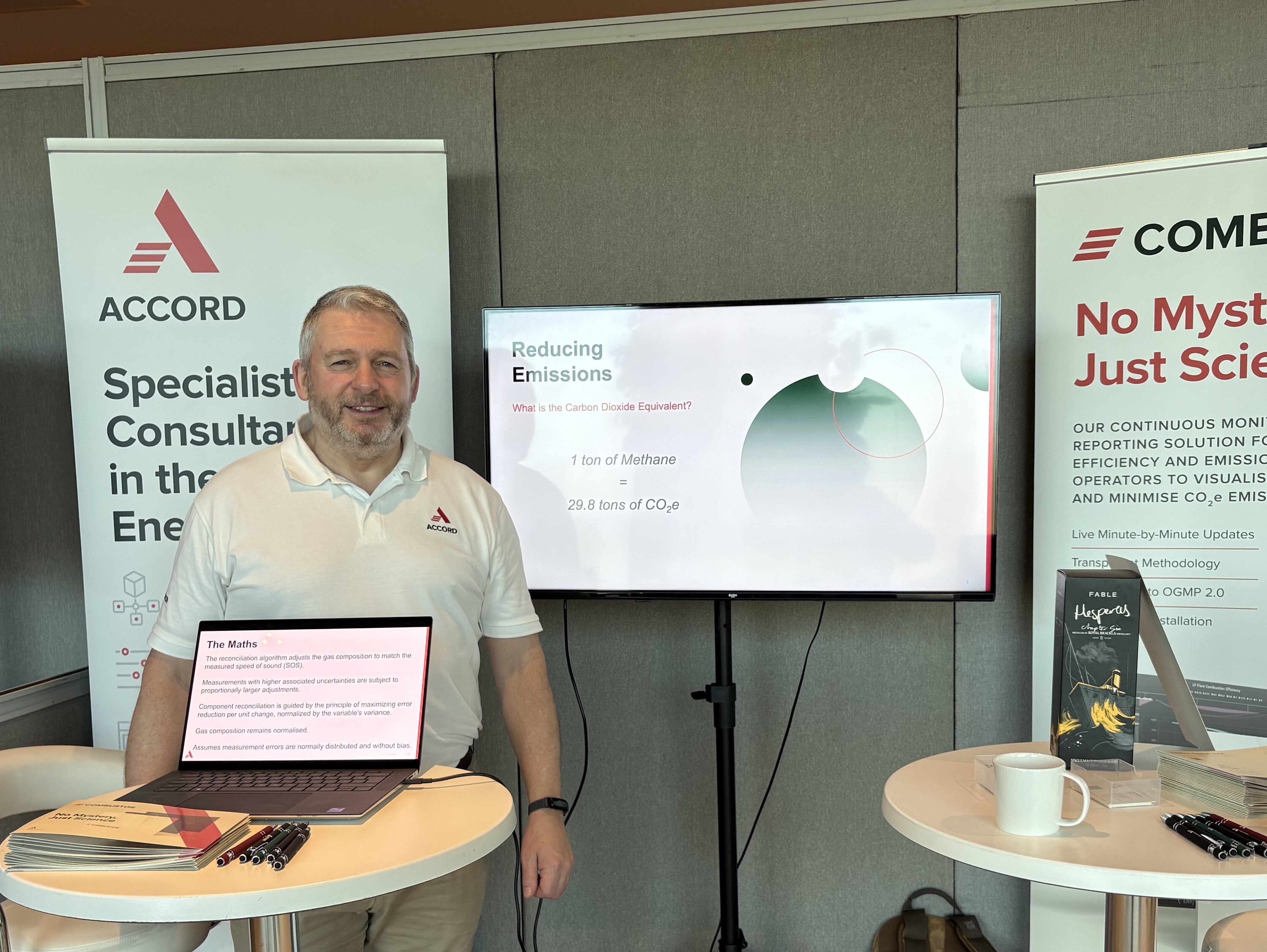
What are some of the biggest misconceptions operators still have about flare emissions and combustion performance?
I think historically the only people who have really been close to this information have been the environmental teams. Because the industry has worked on this assumed 98% combustion efficiency figure for so long, there’s never really been much dispute around the calculation of CO₂ emissions. It became a very standardised approach across the industry, so up until recently there wasn’t really anything contentious about it.
Recent studies, however, have shown that potentially more methane may be being emitted than previously assumed, and because methane has a much higher global warming potential, that’s starting to change the conversation.
The industry has never really had to worry too much about this before. It’s effectively been: apply the 98% figure, calculate the emissions, and move on. That approach has been accepted for years, particularly with existing carbon reporting frameworks already in place, but now there’s growing awareness that methane emissions could become both a regulatory issue and potentially a financial one as measurement methods improve and reporting requirements become more stringent.
At the moment, operators are only slowly starting to turn their attention toward it, because outside of the EU there still isn’t widespread mandatory legislation forcing action yet. But the direction of travel is becoming much clearer.
Why can relying on standard flare assumptions (98% combustion efficiency) create operational or commercial risk?
At the moment, operators are required to have a sampling plan in place to sample the composition of the flare gas. However, the sample points are not always designed properly, or located in the correct place, to capture all of the gas that is actually going up the flare.
This means certain gas components used in the process — such as nitrogen — may not be captured during routine sampling. This can lead to an overestimation of the amount of hydrocarbons and CO₂ being produced at the flare tip.
In practical terms, operators could potentially be reporting — and paying for — more carbon dioxide emissions than they are actually generating.
Through Combustor — Accord’s continuous flare efficiency and emissions monitoring and reporting solution — we can determine the actual composition of the gas at the flare itself. This allows us to account for gases like nitrogen that may otherwise be missed in standard sampling exercises, giving operators a more accurate picture of their true emissions.
How important is transparency in emissions reporting methodology?
I think it’s fair to say that any method used for measuring or calculating emissions has to be completely transparent and auditable, because that’s a huge part of the new EU regulations.
We’ve also heard very clearly from UK regulators that there should be “no more black boxes”, as they describe it. Both the NSTA and OPRED have been very clear that they want to see exactly how emissions are being calculated and how these systems actually work.
In regulatory terms, it’s becoming almost mandatory that operators are able to demonstrate and explain the methodology behind their reporting, rather than simply relying on outputs from systems that can’t easily be verified.
This has really come about because of the deployment of some newer technologies where the methodology is kept proprietary by the manufacturers. The challenge with that is there’s very little visibility into how the calculations are actually being done, or how you independently verify whether the results are correct.
Regulators increasingly want transparency, traceability and confidence in the underlying methodology — not just a number at the end of a report.
What are operators looking for now that perhaps they weren’t five years ago?
Operators are now looking for continuous monitoring of emissions, which is becoming really important for them. They’re also looking for data to feed seamlessly into their existing systems, because a lot of this process used to be very manual. Previously, people would spend weeks gathering information, typing data into spreadsheets, and checking everything manually.
Through a solution like Combustor, the data can go directly into their reporting systems without any manual intervention at all. Operators can access and check the data much more easily.
Many emissions solutions are hardware-heavy. What are the key benefits of lower-intervention solutions?
Many emissions solutions are hardware-heavy, whereas Combustor is a no-hardware solution.
It uses data and information that already exists within the organisation and connects directly to software systems such as PI Vision to run continuously and report emissions data every minute.
Because there is no physical hardware involved, there is no maintainable equipment, no offshore installation requirements, and no additional operational burden. Instead, operators benefit from a continuous supply of emissions data through systems they already use.
"Having a more standardised reporting format helps create greater transparency, consistency and confidence in the data being reported."
From your perspective, how does better emissions reporting support meaningful emissions reduction?
Every energy company wants — and increasingly needs — to maintain a social contract with stakeholders. People want to see that companies are doing everything they can to reduce emissions.
To demonstrate that properly, you need solutions like Combustor running 24/7 to show what’s actually happening. It allows operators to demonstrate that they are actively monitoring emissions and, in some cases, show that they are not emitting as much as people may assume.
It’s also important that this is done in a standardised way. At the moment, companies often report emissions using slightly different methods and slightly different numbers, which makes it difficult to compare performance across operators.
Having a more standardised reporting format helps create greater transparency, consistency and confidence in the data being reported.
What should operators be doing today to prepare for the upcoming methane regulations?
The 98% combustion efficiency figure has been used across the industry for a long time but, in reality, many operators do not fully understand what the true combustion efficiency of their flare systems actually is.
The problem comes when the combustion efficiency on a platform is unexpectedly low. If you have poor combustion efficiency from your flare, that could potentially cost a lot of money if the issue is not identified and fixed before any new methane regulations come in.
That’s why operators should be studying this now. These kinds of problems can take a long time to fix — in some cases, it can take years to investigate and resolve issues on a rig or platform. It’s really about looking ahead and being prepared now, rather than waiting until the regulations are in place.
--------
Combustor is a continuous flare efficiency and emissions monitoring and reporting solution that enables operators to visualise and fully understand their CO₂e emissions, building organisational and regulatory confidence in this data, demonstrating control and mitigating business risk.
Contact us to learn more about Combustor.